Tegra 2 and Flash

Looks like Flash on tablets and smartphones could be in for a serious performance boost this year thanks to Nvidia’s Tegra 2, which was announced at CES. Featuring hardware-accelerated Flash support, Nvidia are claiming a five fold increase in Flash performance on hardware that uses the chip.

Several Flash-enabled Tegra 2 powered devices were announced at the event including the LG Optimus 2X and the Motorola Xoom. I must say the Xoom in particular caught my eye. With most OEMs opting to build 7″ tablets, it really is great to see Motorola have the guts to go with a larger 10″ screen.

With Flash Player and Adobe AIR making it onto more, and increasing more powerful devices, it could be an interesting year for the platform. Oh and Android Honeycomb is looking pretty nice too.

Help Me Obi-Wan Kenobi…

This post has been long overdue.

Firstly, a huge thank you to those who keep enquiring about my X-wing Targeting Computer app. Secondly, please accept my apologies for not posting sooner.

So what have I been up to over the past few months?

Well the app is about as ready as it can be without some external help. Unfortunately the largest hurdle is getting licensing sorted out and it’s proving to be a major problem. I have been in contact with various publishers who were unfortunately unable to take the project on for one reason or another. And getting the contact details for the correct individuals at Lucas Licensing or LucasArts seems to be impossible.

So I guess the only way I can take this project further now is for you guys to re-tweet this post and see if it can make its way into the hands of someone who might be able to help. How does that sound?

I know it’s not what you wanted to hear but unfortunately I’m unable to take this forward on my own and have been advised not to release it onto the Android Market without getting licensing cleared – I don’t want George Lucas sending bounty hunters after me after all.

A huge shout out to those who have already passed me contact details for various individuals they thought might be able to help – Bobby I owe you big time for your patience and help as always. Oh and for those asking for an iPhone version – I did start work on this but I’m not going to continue unless I can get licensing sorted out.

So hopefully someone out there can help me out with this one. Until then I’m afraid I’m the only one who’s gonna know just how awesome it feels to have your very own targeting computer set-up in your car.

Thanks, and may the Force be with you. Always.

Merry Christmas

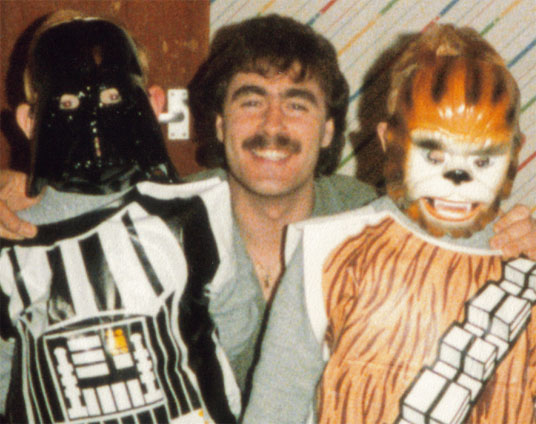
For those who don’t know me, I like Star Wars even more than I like Flash. With Christmas only a few days away I thought I’d share this photo with you guys and tell you a little cautionary Christmas tale.

That’s me and my brother dressed up in those crappy Star Wars costumes. And even though we were only seven, we could tell that ours fell quite short of the originals worn in the movies. The masks we’re wearing can’t even hide our disappointment.

Now call me ungrateful, but when my folks told me that Santa was bringing me a Darth Vader outfit I expected it to be exactly like the one from the film. Not once did they sit me down and try to lower my expectations by explaining things.

So I excitedly counted down the days only to be left mentally scarred by what turned out to be one of the most disappointing Christmases I’ve ever had. Not even a surprise visit from my Unlce Borat, who flew all the way over from Kazakhstan, could cheer me up.

So if you have kids, make sure you’re straight with them about what they’re getting. You don’t want them turning to the dark side do you.

Now don’t get me started on the fake Lightsaber I got the year before. Oh and have a great Christmas and New Year!

GPU Rendering on iPhone and Android

I’ve been meaning to write this post for a few months now but never seemed to find the time. It’s related to my Packager for iPhone: Render Performance article and regards rendering differences between content written for AIR for Android and the Packager for iPhone.

In short, the article highlighted the performance problems when playing timeline animations on iPhone and instead suggested the use of ActionScript to create bitmap animations by flicking between a collection of BitmapData objects, where each BitmapData object represented a frame of the animation.

With GPU acceleration enabled, using ActionScript to run these bitmap animations was easily improving performance by a factor of at least 6 compared to the traditional timeline approach.

Even constructing timeline animations that held bitmaps on each frame (rather than vectors) failed to match the performance that could be achieved from using the ActionScript outlined in my examples.

This is shown in the video below, where 23 animating objects are randomly placed on the screen. Each animation is 4 frames long, with each frame being represented by a 274 x 366 bitmap. The first app launched in the video uses the traditional movie clip approach, with the animation being constructed on the timelime. The second app uses ActionScript to produce the same effect. Both apps use GPU rendering mode. The difference in frame rate between the two apps is quite noticeable.

So does the same hold true for AIR for Android?

Well to be honest I had initially assumed it would and hadn’t actually bothered checking. But when I eventually did get round to it I was pleasantly surprised. It turned out that when using GPU acceleration, bitmap animations on the timeline run just as fast as their ActionScript counterparts. When running both tests using CPU render mode, the ActionScript code was faster but only by about 50%.

The video below shows the same demo’s from the iPhone example, but running on Android. This time the traditional movie clip approach performs just as well as the ActionScript-based animation.

This news is good and bad.

It’s good because for AIR for Android projects I can start using movie clips and the timeline for creating animations again, which is a huge time saver and gives me all the benefits I expect from using Flash. On the other hand, it’s bad because the rendering differences between my iPhone and Android apps mean that if I want to target both platforms I’ll need to continue to use an ActionScript-based solution, which adds to the development time.

So why do apps written using the Packager for iPhone seem to struggle so much? Perhaps this Adobe MAX session by Adobe AIR engineer David Knight and platform evangelist Renaun Erickson sheds some light. It seems that Adobe’s implementation of GPU rendering mode for iOS works slightly differently to their Android implementation.

Rendering typically comprises of two parts: rasterizing and scene composition. When GPU rendering is used on iOS devices, the rasterizing always takes place on the CPU, with only the composition taking place on the CPU. For Android, both rasterizing and composition take place on the GPU. In other words, for movie clip animations, each frame the playhead moves to, must first be rendered into a pixel buffer in RAM before being copied to the GPU. This is expensive and I’m guessing is the reason Flash performance is impaired on iPhone.

So is this something that Adobe is likely to change in the future or is it a limitation of the iPhone’s hardware? Personally I don’t know the answers to that but it would be great to know.

Right now, this subtle rendering difference seems to be the reason why Flash developers are experience so much pain developing apps for iPhone.

For anyone who’s interested I ran the two tests across several devices and using both CPU and GPU rendering modes. The results are shown below and include the frame rate that the test managed and the number of pixels that were rendered per second.

It was hardly the most formal of tests but each app attempts to display 23 animating objects and measures the number of frames that were successfully rendered over a 5 second period. From that the frame rate is calculated. Each display object is 274 x 366 pixels in size, meaning that 2,306,532 pixels need to be rendered per frame in order to draw all 23 display objects.

Results

Device Animation Type Render Mode Frames Per Second Pixels Per Second
1st gen iPod touch ActionScript GPU 12 27,678,384
ActionScript CPU 5 11,532,660
Timeline GPU 2 4,613,064
Timeline CPU 2 4,613,064
2nd gen iPod touch ActionScript GPU 15 34,597,980
ActionScript CPU 7 16,145,724
Timeline GPU 2 4,613,064
Timeline CPU 2 4,613,064
iPhone 4 ActionScript GPU 56 129,165,792
ActionScript CPU 17 39,211,044
Timeline GPU 5 11,532,660
Timeline CPU 5 11,532,660
Google Nexus One ActionScript GPU 23 53,050,236
ActionScript CPU 12 27,678,384
Timeline GPU 23 53,050,236
Timeline CPU 8 18,452,256
Samsung Galaxy S ActionScript GPU 29 66,889,428
ActionScript CPU 12 27,678,384
Timeline GPU 29 66,889,428
Timeline CPU 7 16,145,724

If any of my calculations look disastrously wrong then let me know.

You can find the source files for the tests here.

Feel free to test on other devices and send me your results.

Oh, and for faster devices you may want to increase the FPS setting within the FLAs. At the moment the Android FLAs are capped at 30fps while the iPhone FLAs are capped at 15fps. I had to increase the frame rate setting when testing on iPhone 4 to 50fps after noticing the original test results were reporting 14/15fps.

Adobe Flash Player 10.2

Okay, so Flash Player 10.2 beta has been available on Adobe Labs for a good few days now, and if you haven’t already installed the beta then it might just worth your while.

The biggest addition in 10.2 is Stage Video hardware acceleration, which should see CPU usage significantly reduced, enable higher frame rates, and reduce memory usage. Unlike traditional video playback, Stage Video does not sit inside Flash’s display list. Instead it sits behind the stage and takes full advantage of the underlying video hardware, maximising performance.

Sites such as YouTube are actively embracing Flash Player 10.2 and Stage Video, but if you want to take advantage of it in your own Flash projects you’ll actually need to re-write your existing video playback code. To be honest, it’s not a huge amount of effort and you should find both Thubault Imbert’s ‘Getting started with stage video’ and Mihai Corlan’s ‘Working with Stage Video’ perfect articles for learning how to do it.

Sticking with video, you’ll also be pleased to know that 10.2 also has support for full-screen mode with multiple monitors. So what exactly does this mean? Well, full-screen content will now remain in full-screen on a secondary monitor even while you work away on your other screen. Nice one Adobe!

Also of interest, is the native custom mouse cursor support that has also made it into Flash Player 10.2. You no longer need to hide the native mouse cursor and replace it with a movie clip equivalent that is locked to your SWF’s frame rate. Now you have full ActionScript control over the appearance of the native mouse cursor. For a tutorial, head back over to Mihai Corlan’s blog.

So some worthy additions. Remember it’s still in beta at the moment but definitely worth giving Flash Player 10.2 a spin.

Happy Birthday Blog!

Hard to believe but my blog is one year old today.

Have a slice of this virtual cake on me.

Om nom nom nom.

Building an iPhone App Using Flash

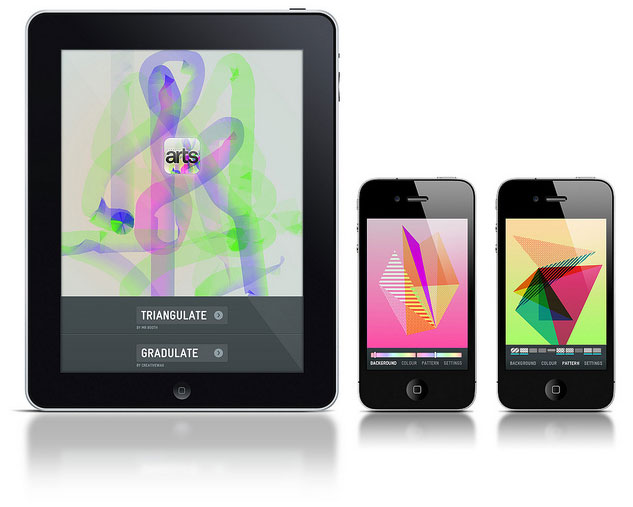
I popped into my local newsagents and noticed a rather interesting issue of Computer Arts Projects. Almost a third of the magazine has been given over to an extended project detailing how the all-new Computer Arts app for iPhone and iPad, called Visualator, was built using Flash Professional CS5.

The magazine takes you through all the steps, from concept, through UI design, to actually publishing your app and submitting to the App Store. I couldn’t leave without buying it so I’ll give it a read tonight and let you all know what I think. If you’ve always fancied dabbling with mobile development using Flash then it might be a good introduction.

Flash Mobile Development Links

Flash development on mobile is starting to pick up some momentum, be it Flash Lite on Nokia devices or AIR-based apps for Android.

So if you’re at all interested in Flash for mobile then head over to Alessandro Pace’s blog where you’ll find everything from tutorials to white papers all conveniently listed in the one post. Really great post Alessandro!

For those interested in BlackBerry’s PlayBook I strongly recommend you check out this excellent article by Junchao Ji detailing how to build AIR applications for the BlackBerry Tablet OS. And remember, developers who create a qualifying application for the BlackBerry PlayBook prior to its initial North American release are eligible for a free BlackBerry PlayBook tablet. Head over here if you want to know more.

Last but not least, for anyone building iPhone apps with Adobe’s Packager for iPhone this Guide for Apple App Store submissions might be of interest. The article covers many topics including device performance, usability and setting up distribution certificates.

Flash Stigma

When did Flash become such a dirty word?

I ask because I was flicking through the pages of a magazine the other day when I noticed an article comparing Apple’s iPad to Blackberry’s upcoming Playbook. To help potential buyers make a decision the magazine had kindly provided a summary with Pros and Cons for each device.

I was shocked to see the following listed as a negative against the Playbook: ‘Supports Flash’. WTF!? I honestly had to do a double-take. But yup, sure enough the author had clearly decided that offering the user the choice to view the thousands of Flash-based web sites and games out there was somehow a bad thing.

Now I could fully understand if the Playbook’s Flash Player performance was poor and the magazine was taking a dig at that, but to knock a device simply for providing support for a well established technology just seems crazy.

I’ve also noticed similar hatred towards Flash on the Android Market, where apps written using Adobe AIR have been getting negative reviews because of the technology they use.

Does Flash deserve the criticism it’s getting at the moment and what can Adobe do to rectify the situation?

I think I’ll leave my own thoughts on this for another post but feel free to let me know what you think.

Does Apple Need Flash?

A day doesn’t go by without someone speculating that Apple will eventually be forced to include the Flash player on iPhone and iPad in an attempt to fend off the ever increasing Android user base. Personally I don’t see this happening for two reasons.

Firstly, the majority of people aren’t buying Android devices for the Flash support. In fact, I strongly suspect many are buying handsets without even knowing, or caring, that their new device is actually running the Android OS. Android is everywhere now and it’s getting harder to purchase a phone that doesn’t use it. Sure there’s probably many Symbian users disgruntled with Nokia’s ageing OS that have gone over to Android, but again the vast majority probably aren’t using Flash as a deciding factor.

But the main reason I doubt Flash Player will make an appearance on iPhone is that it’s clear Apple doesn’t really need it. iPhone user’s have been getting by surfing the web without Flash for almost four years now, and many of the more popular websites have slowly started to move over to using JavaScript to provide some of the interactivity that was once done in Flash. As for web-based games, again Apple has shown that it doesn’t need Flash here either. The quality of games available through the App Store is nothing short of exceptional and we’re constantly seeing new and innovative ideas.

I’m certainly not taking a swipe at Android or Flash with this post. My primary phone at the moment is an Android and I make a living as a Flash developer. Personally I’d love to see Flash on iPhone and especially the iPad but I’m not going to hold my breath for it.