AS3 iPhone Components

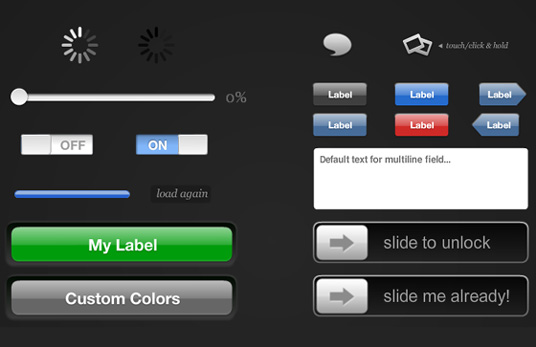
Pop over to NoRestForTheWicked and you’ll find a set of nifty ActionScript 3 iPhone components by Nick Jonas. He’s decided to start small but what’s there looks great and should come in handy for anyone wishing to prototype potential iPhone UIs in Flash or for those simply wanting to get a head start with their Flash CS5 Professional iPhone projects.

Currently the SWC comes in at a tidy 72 Kb and the components themselves can be added to your project using only a few lines of code. In fact, from his site you can preview the components and even click on a link next to each to generate the code required to set it up; it really couldn’t be simpler. You won’t be able to use any of the iPhone’s native UI components from within Flash so Nick’s components will no doubt be a lifesaver for many.

Flash Lite 4

Spotted an interesting article on Scott Janousek’s blog stating that Flash Lite 4 is now available from Calsoft, one of Adobe’s partners responsible for getting the Flash Lite run-time working across various chipsets.

So why another version of Flash Lite? Isn’t Flash Player 10.1 for mobile going to make Flash Lite redundant?

Well not quite yet. Given the minimum device spec (order of a minimum of 600 Mhz ARM11) required to run 10.1 it’s going to be some time before there’s significant penetration across a wide range of devices. Plus whereas 10.1 is a browser only plug-in, Flash Lite 4 is both standalone and a browser plug-in.

So while developers can get to work straight away writing Flash Lite 4 applications and games for various distribution channels, those wishing to target Flash Player 10.1 will need to wait for AIR 2.0 to roll out across mobile.

Many may look down on Flash Lite as nothing more than a stunted version of Flash 10, but it makes a lot of sense for those wishing to write apps quickly or for those who simply want to port their existing web based games to mobile with minimum fuss. Its support for ActionScript 3 should make porting significantly easier than before where many developers would previously have had to actually re-write their code in ActionScript 2.

Outside Japan, Flash Lite doesn’t seem to have had the success Adobe would have hoped for. It’ll be interesting to see if that changes with Flash Lite 4.

Help shape the future of Flash

Been holding your breath for Flash Professional CS5? Well Adobe have finally announced that it’ll be available from April 12th. CS5 has an impressive list of new features but I’m sure as always there will be someone out there who has just had a great idea that isn’t going to appear in this release.

To be honest I think the Adobe engineers will probably try and strangle you if you ask them to squeeze it into CS5 this close to release, but all is not lost. You see, those kind people at Adobe have created Adobe Labs Ideas where you can suggest new features for future versions of Flash or vote for a suggestion that’s already been added. So what are you waiting for?

So far, here’s the suggestion that seems to have gotten most votes.

It would be nice if Flash CS5 could automatically inject some humanity and rationale into Steve Jobs and make him realize Apple (and thus, he) cannot grip the Interwebs in an iron fist of greed and censorship. I understand this may take a few unusual new class files and data objects, but I have faith in the Adobe team’s superior engineering capabilities.

I imagine it won’t be that hard to implement. Oh and while they’re at it I hope Adobe take my own feature request seriously. Again, it should be fairly easy to implement:

I’d like a class that allows mobile phones to be used as real lightsabers. The API should allow a blade of plasma energy to be extended for one meter from the end of the handset. It should also allow for the colour to be adjusted between blue, green and red.

Thanks Adobe! Looking forward to seeing these two features implemented in Flash Professional CS6.

Our new programmer hates Flash

Our new programmer Ian had managed to avoid using Flash since arriving at WeeWorld, but his luck ran out the other day when he was asked to work on some legacy ActionScript 2 code. I had a bad feeling he wasn’t going to enjoy it, partly because he’d just recently declared C# his new all-time favourite language, but mostly because AS2 is quite rubbish.

Sure enough, 30 minutes in he started muttering stuff under his breath and striking the keys on his keyboard just a little too hard. About an hour later he started shaking his head in disgust and became quite vocal about how backwards everything seemed. By mid-afternoon he’d become delarious and had stopped responding to instructions. Come five o’clock the poor guy looked like he’d suffered some kind of brain injury.

Thankfully he seems to be on the mend but is now insisting that he hates Flash. Maybe he’ll respond better to ActionScript 3.

Do people know what Flash is or care?

Most of you will have seen the ‘What is a browser?’ video where Google take to the streets of New York to see how many passers-by actually know what a web browser is. Even though they all seemed to surf the web regularly, only 8% of them knew what a web browser actually was. Well the video sparked an interesting conversation in the office between myself and a friend.

One question in particular came out from the conversation: Do people actually know what Flash is?

It would be really interesting to see a similar video asking this question to random folk. I suspect the results would be much worse than the miserable 8% from the Google video. Many of my friends and relatives know that I’m a Flash developer, but whenever I try explaining to them what Flash is their eyes glaze over, with some even seeming to slip into a semi-vegetative state.

So is this really a problem? Well it shouldn’t be. Your average user should just be able to enjoy browsing the web without caring about what technologies are being used to render the content. Unfortunately with the increasing penetration of the iPhone and the imminent release of the iPad looming, Adobe could be in trouble.

Most iPhone users, and I’d imagine this will be the case for those with iPads too, will probably get by with a stunted web experience. iPhone users have after all been making do with a Flash-less web for some time now and I suspect that most of them simply shrug their shoulders and move on when they stumble upon a Flash-based site.

If people don’t know what Flash is or even care then how are phone and tablet manufacturers going to convince them to purchase their Flash-enabled devices over Apple’s products? Other than geeks, who’s going to buy an Android phone because it says on the box that it supports Flash? Claiming that Flash-enabled devices will allow users to browser ‘the complete web’ isn’t going to do much good either, since Joe Public already mistakenly believe that the iPhone and iPad can already do this.

For me it’s difficult to see round this problem. Perhaps the trick is not to mention Flash at all, instead focusing marketing on popular Flash sites that will only be available to these Flash 10.1 enabled devices. Or maybe Adobe are just hoping that the handsets they’re targeting will eventually grab a large enough market share giving Flash the mobile penetration it needs to be relevant.

My main concern however is the time this will take. The longer iPhone and iPad dominate in their spaces, the more websites will drop Flash in order to cater for the ever increasing number of users who have Apple devices.

I’m extremely excited by the prospect of seeing Flash on mobile but there is an ever decreasing window of opportunity to get Flash 10.1 out there. Let’s hope that Adobe and its many partners manage to get Flash on enough devices before a tipping point is reached and websites stop using it.
The HP Slate and Flash

The iPad is a fantastic looking device but with so many manufacturers jumping on the tablet bandwagon it’ll be interesting to see what influence Flash support will have on consumers looking to make a purchase. Unlike the iPad, HP’s Slate will run the full internet, which means full support for Flash Player 10.1 and Adobe AIR.

In the video above, Alan Tan, product marketing manager at Adobe demonstrates Flash and AIR applications running on the Slate. It’s a nice looking device and the performance on the whole seems to be very good. Let’s hope HP get the price point right and that it appears nearer the first half of this year rather than the second.

Flash Lite 3.0 “out of memory” bug

Developing GamesFlash over the last few years was a great learning experience and, as I’ve said before, was something I was extremely proud of. There were times however when I felt like giving up. Although Flash Lite was a great stepping stone towards a full mobile version of the Flash player, there were terrible fragmentation issues across devices and a frustrating number of bugs introduced across various versions of the Flash Lite run-time.

When I decided to eventually add video support I came across one problem in particular that nearly lead to me having a nervous breakdown. Testing GamesFlash directly from the phone’s Flash Player application or within Device Central indicated that the Series 60 devices should each have approximately 4 Mbytes of dynamic heap available, which was enough for video support to work quite well. However, after packaging as a SIS file using various SIS packagers, I noticed that GamesFlash was suddenly only allocated 2 Mbytes of dynamic heap, which wasn’t nearly enough to comfortably run video. It resulting in the dreaded “out of memory” dialog appearing at run-time after playing a handful of videos.

Having used SWF2Go for the bulk of my SIS packaging I contacted lead developer Faisal Iqbal (AKA chall3ng3r) to see if he could shed some light on the problem. Unfortunately a workaround wasn’t forthcoming but at the time Adobe’s Distributable Player Solution came to the rescue as it packaged content without the same memory issues. With the Distributable Player Solution now cancelled I often wondered how others got round the memory problems I was having. Surely I wasn’ t the only one suffering from these memory issues.

Well I got an answer today thanks to a Tweet from chall3ng3r. Looks like it was a memory allocation bug in Flash Lite 3.0 on S60 devices, which makes memory settings in the stub launcher obsolete. Nokia have now fixed this issue and the fix is available in Flash Lite 3.1 via a firmware update. The posts made by chall3ng3r on the SWF2Go Forum indicate that the problem is specific to 5th Edition devices. I wonder if that’s a mistake as I definitely experience the same problem on 3rd edition devices such as the N95.

Happy Birthday Adobe AIR

Yup, it’s hard to believe but Adobe AIR is now two years old and it’s incredible just how far it has come in that short space of time. Given the growing debate over Flash’s future within the browser it’s often easy to forget that the Flash platform allows developers to create rich Internet applications that can be deployed to the desktop across multiple operating systems.

AIR now powers a variety of applications used by enterprises and everyday consumers in applications for social networking, gaming, eLearning, subscription-based services, video, productivity tools, collaboration services, and so much more. And thanks to its support for iPhone, which is due to be delivered as part of the Flash Professional CS5 release, 2010 will be a very exciting year indeed for AIR.

If you are in any doubt at all regarding the power of Adobe AIR, take a look at the video above, which demonstrates a collaboration between Adobe and Wired magazine to produce a new digital magazine concept running on an Android-based tablet. It’s quite stunning.

AIR for Android

Good news folk! Adobe have announced at Mobile World Congress their plans to bring Adobe AIR to mobile devices, starting with Android and Blackberry handsets. So what does this mean for us Flash developers? Well basically it means we’ll be able to write kick-ass mobile apps and sell them on the Android and Blackberry app stores. Check out the video below to see some content running on the Motorola Droid.

Performance looks really good and should excite Flash developers eager to generate revenue from the mobile ecosystem. Unlike Flash Lite, which is somewhat stunted, AIR apps will run the full Flash 10.1 experience, store data locally on the phone and also allow access to other data including photos. This is another significant step for the Flash platform with developers, in theory, being able to write apps that will run consistently across both web and mobile. Plus with Flash Professional CS5 on the horizon, iPhone apps will also be a possibility.

AIR on Android will be available in the second half of 2010.

Where has Forum Nokia’s Online Packager gone?

What the heck is going on with Forum Nokia’s Online Flash Lite packager? It must be months now since Nokia put the project on hold meaning anyone with great Flash Lite content that they’d like to package and distribute will have have to look elsewhere for an alternative.

It’s a real shame because the online packager removed the need for Flash Lite developers to have to install the Symbian S60 SDK directly on their PC. It also meant that Mac owners could package their content without having to get access to a PC. Currently Nokia’s only suggestion is to indeed install the Symbian SDK on a PC and write a Flash Stub application using Carbide c++. For some it’s probably more effort than it’s worth.

It’s just another frustration for those wishing to create Flash Lite applications for the wide range of Nokia devices out there.

All is not lost though. It certainly doesn’t look like the Online Packager solution is gone for good. In fact Forum Nokia has this statement on its site:

We are looking into providing a reliable online packaging solution for Flash… Sorry for any inconvenience caused by this action. We did get a lot of valuable feedback for our next version and wish to thank you all for your input.

It would be great if there were some more details released regarding the new packager. Is there a scheduled release date for it and what new features are we likely to see? If anyone knows then please get in touch.

And when the Online Packager does eventually re-surface let’s hope that Nokia have fixed the ridiculous signing process for Flash Lite content. I don’t really understand why Flash Lite content for Series 40 devices can be packaged in a simple NFL file and distributed without signing, whereas all S60 Flash Lite content has to be Symbian Signed and distributed as a SIS file.

Can’t we just have something similar to the NFL format on S60 devices? Currently it’s just too expensive and time consuming for those writing freeware apps to get their work onto the OVI store. I think it’s also still the case that anyone wanting to release content on the OVI store has to be VAT registered (please someone correct me if I’m wrong) before being allowed to submit content. This again just seems crazy and must surely be preventing many great creative individuals from submitting interesting and free apps to the OVI store.

I also noticed that Alessandro Pace also has similar thoughts regarding the NFL format, suggesting that Nokia push it out across all their devices.

Oh and if you are looking for an alternative packaging solution I’d suggest you take a look at SWF2Go Professional by Faisal Iqbal.